Orkyo is production scheduling software for manufacturing teams. It answers a question spreadsheets and whiteboards answer badly: what is every machine, person and tool doing this week, and what happens to the delivery date when one of them is unavailable?
Work in Orkyo is a request — a job, an order, an operation — scheduled onto the resources that carry it out. Resources come in two shapes. Stations are the located things: machines, workstations, cells, benches, rooms. They can be placed on a floorplan, so the schedule reads as a picture of the shop rather than a list. Assets are the things that move between stations: operators, teams, tooling, fixtures. Resource types are yours to define, so a shop that thinks in presses and moulds and a lab that thinks in benches and analysts each get their own vocabulary.
Scheduling is constraint-aware, not a calendar with a nicer skin. Resources carry capabilities and requests carry requirements, so Orkyo knows a job needing five-axis milling cannot go on a three-axis machine, and says so as you place it. It checks availability against shifts, maintenance windows, holidays and absences. Overbooking, capability mismatches and availability clashes surface as conflicts on the board, colored by severity, instead of as a surprise on the floor. An optimizing scheduler built on Google OR-Tools CP-SAT can place work for you across a whole horizon.
Jobs rarely stand alone, so requests can depend on each other. Orkyo models finish-to-start dependencies with lag, rejects cycles, and computes the critical path — the chain of work that actually determines the finish date, and how much float everything else has.
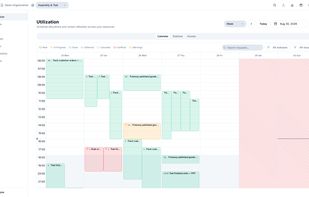
Utilization views show capacity against demand over any window, per site and per resource type. Bottleneck charts rank the most constrained stations and assets, so the next investment decision is grounded in the schedule. Every resource has its own calendar for managing bookings and absences, and schedules publish as subscribable calendar feeds. Data moves through import, export and a reporting API.
The platform side suits real operations: single sign-on via OpenID Connect, role-based permissions, per-tenant audit trails, multi-site support and GDPR-aligned data lifecycle handling.
Orkyo is not an ERP, MES or CMMS and does not try to be. It does not take your orders, drive your machines or manage your spare parts. It sits between those systems and does the one thing they all do reluctantly: scheduling finite, shared, constrained capacity.
Orkyo Cloud is the hosted, managed service, with a live demo available without signup. Orkyo Community is a free, fully self-hostable edition under AGPL-3.0: single-tenant, deployed with Docker, source on GitHub, no feature paywall on the scheduling core.







 Orkyo
Orkyo 


No comments or reviews, maybe you want to be first?