
OpenHuman icon
OpenHuman icon

OpenHuman

 1 like

The fastest, cheapest, most efficient open-source agent harness. Run more than 500 agents on a $10 VPS.
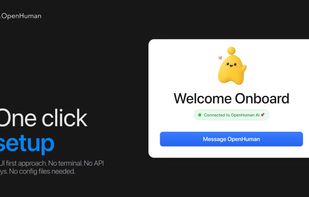
OpenHuman screenshot 1

Cost / License

Platforms

  • Mac
  • Windows
  • Linux
  • AppImage
1like
0articles
Save

Features

Properties

Features

Highlights All activities

OpenHuman News & Activities

Recent activities

OpenHuman information

AlternativeTo Categories

System & Hardware, AI Tools & Services

GitHub repository

  •  41,817 Stars
  •  4,114 Forks
  •  306 Open Issues
  •   Updated  
View on GitHub
OpenHuman was added to AlternativeTo by Paul on and this page was last updated .

No comments or reviews, maybe you want to be first?

Official Links

What is OpenHuman?

The fastest, cheapest, most efficient open-source agent harness. Run more than 500 agents on a $10 VPS. A desktop app for people. A Rust library for developers.

Why OpenHuman?

Most agent harnesses run one heavy process per agent and resend a big prompt on every call. OpenHuman does the same work with far less. It is the only feature-rich open-source harness built for large fleets of agents: 500 of them fit on a $10 server.

  • Fast: Finishes coding tasks in about 20 seconds, the fastest of seven AI agent tools we tested. Starts up in a tenth of a second.
  • Cheap: Uses 2.6x fewer tokens than the typical agent tool, and had the lowest total bill in our test.
  • Efficient at scale: Uses about 8x less memory and CPU than the typical agent tool. Run more than 500 agents on a $10 server.
  • Built for developers: Use it as a Rust library: call an agent like any other function, or run a whole fleet from one small server.

Major innovations

Most agent harnesses are a simple loop: send everything to the model, wait, repeat. That works for one agent, but it gets slow and expensive quickly, and it falls apart when you run hundreds.

OpenHuman rethinks the parts that cost the most: how much text the AI has to read, how it finds the right tool, how features load, and how much machine the whole thing needs. The six ideas below are where the speed and savings above come from. Each card links to the docs if you want the details.

  • RLM token compression: Built on Recursive Language Models. Large tool results get compressed before the AI reads them. For very large ones, the AI gets a handle it can search instead of reading it all. Nothing is thrown away.
  • Jev: instant, accurate tool search: Jev is a tiny model that finds the right tool out of 1,215. The right one is in its top picks 86.8% of the time, against 70.5% for keyword search.
  • Unified Rust bus: Every feature, like search, documents or voice, plugs into one Rust bus, an idea borrowed from the Linux system bus. A feature loads only when needed, and if one gets stuck, the rest keep working.
  • Deeply integrated memory: Memory comes built in. Before every turn, OpenHuman picks out only what matters, within a token budget, and hands it to the AI with citations. It works out of the box, and you can swap in a different memory engine with a setting.
  • Instant browser and desktop control: The agent uses a real browser and your desktop apps. Jev picks each click from the buttons on screen, with no screenshots. It stops before any payment.
  • A programmable Rust core: The whole harness is compiled Rust in one process, so it starts in a tenth of a second and stays light: 68 MB at peak on our coding tasks. The same core is a library. Call an agent from your own Rust code, or run hundreds of them side by side on one small server.