

onsubmit.dev
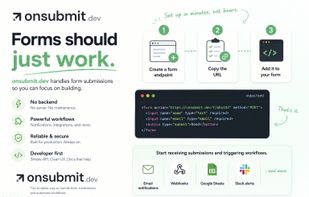
onsubmit.dev is a backend-as-a-service for web forms that lets developer collect form submissions without a server. It works with static websites and modern frameworks. Offers email notifications, webhooks, integrations, spam protection, and an intuitive dashboard for managing submissions.
Cost / License
- Freemium (Subscription)
- Proprietary

Platforms
- Online
Features
- Lead Capture
onsubmit.dev News & Activities
Recent activities
- ekwoster liked onsubmit.dev
- ekwoster added onsubmit.dev
ekwoster added onsubmit.dev as alternative to Formrule, Forminit, Wufoo and velto.tools
onsubmit.dev information
What is onsubmit.dev?
onsubmit.dev
onsubmit.dev is a backend service for handling HTML form submissions without requiring your own server or backend code. It is designed for developers building static websites, JAMstack applications, and modern frontend projects who need a reliable way to process contact forms, newsletter signups, feedback forms, and other user submissions.
Instead of creating a custom API, configuring serverless functions, or managing backend infrastructure, developers simply point their HTML form to an onsubmit.dev endpoint. Submitted data is securely processed and made available through a web dashboard, email notifications, webhooks, and third-party integrations.
The service works with any website or framework and offers official integration packages for Astro, Next.js, React, Vue, and Svelte, making setup straightforward while still supporting plain HTML forms.
Key features
- Handle HTML form submissions without a custom backend
- Works with static websites and any hosting provider
- Official integrations for Astro, Next.js, React, Vue, and Svelte
- Email notifications for new submissions
- Webhooks for connecting your own services
- Integrations with popular automation tools
- AI-powered automatic email responses
- Submission history and management dashboard
- Spam protection
- Simple REST API
- Supports multiple forms and projects from a single account
onsubmit.dev is suitable for portfolios, business websites, landing pages, documentation sites, blogs, and any project where adding a traditional backend would be unnecessary or overly complex. It enables developers to keep the simplicity and performance of static sites while still providing fully functional forms.