odio streamer icon
odio streamer icon

odio streamer

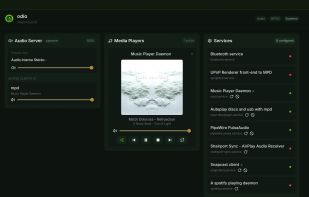
A free, self-hosted music streamer. odio installs as a service stack, adding AirPlay 2, Spotify Connect, Bluetooth, DLNA, Snapcast multi-room, Webradios, CD/USB auto-play with metadata. Home Assistant compatible.

Audio CD with metadata and cover

Cost / License

Platforms

  • Android
  • iPhone
  • Self-Hosted
  • Ubuntu  = 24.04
  • Debian  Trixie
  • Raspberry Pi OS  Trixie
1like
0comments
0articles

Features

Properties

  1.  Privacy focused
  2.  Lightweight

Features

  1.  Lossless Audio
  2.  Works Offline
  3.  Ad-free
  4.  Extensible by Plugins/Extensions
  5.  No Tracking
  6.  Dark Mode
  7.  No registration required
  8.  UPnP Renderer
  9.  Home Automation
  10.  Progressive Web App
  11.  Stream audio
  12.  Internet Radio

odio streamer News & Activities

Highlights All activities

Recent activities

odio streamer information

  • Developed by

    FR flagb0bbywan
  • Licensing

    Open Source (BSD-2-Clause) and Free product.
  • Alternatives

    2 alternatives listed
  • Supported Languages

    • English

AlternativeTo Categories

Audio & MusicHome & Family

GitHub repository

  •  34 Stars
  •  2 Forks
  •  1 Open Issues
  •   Updated  
View on GitHub
odio streamer was added to AlternativeTo by b0bbywan on and this page was last updated .
No comments or reviews, maybe you want to be first?

What is odio streamer?

odio turns any Raspberry Pi into a self-hosted, open-source audio streamer. It is not a custom distribution: it installs as a stack of services on top of an existing Raspberry Pi OS Lite (or Debian 13 / Ubuntu), with near-zero system changes. The same install runs on every Pi from the original 2012 Model B (armv6l) to the Pi 5, and on x86-64 desktops or NAS. A single node speaks every modern audio source at once, with no source switching: AirPlay 2, Spotify Connect, Bluetooth A2DP, UPnP/DLNA, MPD, and PulseAudio/PipeWire network streaming. It plays inserted CDs and USB drives automatically with cover art and metadata (MusicBrainz, GnuDB), handles thousands of web radios, and reaches the Qobuz and Tidal catalogs (hi-res / lossless) through upmpdcli. Snapcast provides perfectly synchronized multi-room playback.

Every node exposes a documented REST API (go-odio-api): playback, volume, sources, Bluetooth and services are all programmable over HTTP, so you can build your own clients, automations, parental controls, or voice control (Piper, Whisper via Home Assistant). A native Home Assistant integration exposes the full stack (power, outputs, Bluetooth, services) as HA entities, not just a media-player card. A PWA gives a native-feeling control interface on any device. odio is free and fully open source under BSD-2-Clause, with no account, no cloud dependency, and no telemetry. Installation is a one-line curl command or a pre-built image flashed via Raspberry Pi Imager (armhf and arm64). Upgrades happen in place via odio-upgrade, and SD images ship continuous unattended security updates.

A free, self-hosted alternative to Volumio, moOde and commercial network streamers, built for makers and developers who want to own their setup. Currently in beta: daily use is solid.

Official Links