Moshi is a speech-text foundation model and full-duplex spoken dialogue framework. It uses Mimi, a state-of-the-art streaming neural audio codec.
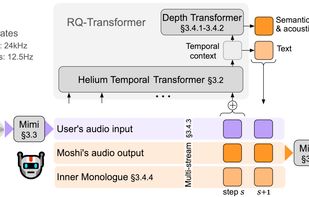
Moshi models two streams of audio: one corresponds to Moshi speaking, and the other one to the user speaking. Along with these two audio streams, Moshi predicts text tokens corresponding to its own speech, its inner monologue, which greatly improves the quality of its generation. A small Depth Transformer models inter-codebook dependencies for a given time step, while a large, 7B-parameter Temporal Transformer models the temporal dependencies. Moshi achieves a theoretical latency of 160ms (80ms for the frame size of Mimi + 80ms of acoustic delay), with a practical overall latency as low as 200ms on an L4 GPU.
Mimi
Mimi is a neural audio codec that processes 24 kHz audio, down to a 12.5 Hz representation with a bandwidth of 1.1 kbps, in a fully streaming manner (latency of 80ms, the frame size), yet performs better than existing, non-streaming, codecs like SpeechTokenizer (50 Hz, 4kbps), or SemantiCodec (50 Hz, 1.3kbps).
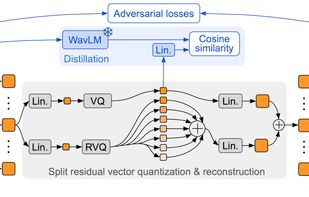
Mimi builds on previous neural audio codecs such as SoundStream and EnCodec, adding a Transformer both in the encoder and decoder, and adapting the strides to match an overall frame rate of 12.5 Hz. This allows Mimi to get closer to the average frame rate of text tokens (~3-4 Hz), and limit the number of autoregressive steps in Moshi. Similarly to SpeechTokenizer, Mimi uses a distillation loss so that the first codebook tokens match a self-supervised representation from WavLM, which allows modeling semantic and acoustic information with a single model. Finally, and similarly to EBEN, Mimi uses only an adversarial training loss, along with feature matching, showing strong improvements in terms of subjective quality despite its low bitrate.






 EU


 Kyutai




No comments or reviews, maybe you want to be first?