

Hiberden
Archive files to LTO tape, disk, NAS and S3-compatible cloud from one catalog, with every copy proven by read-back verification.
Cost / License
- Pay once
- Proprietary
Platforms
- Windows
- Linux
- Mac
- BSD


Hiberden
Features
Properties
- Lightweight
- Privacy focused
Features
- No Tracking
- Ad-free
- Works Offline
- Command line interface
Support for Amazon S3
Hiberden information
What is Hiberden?
Hiberden is a desktop archiving application for people who keep files for years rather than days: camera masters, finished deliverables, research data, and anything else that has to still be readable long after the project is closed.
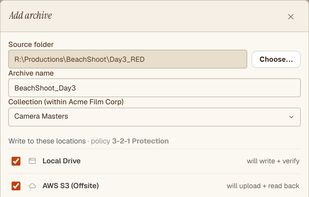
It writes archives to four kinds of destination from a single catalog: LTO tape, local disk, NAS, and S3-compatible cloud storage. One archive operation fans out to every destination in your policy, so you are not juggling three separate vendors' tools to keep three copies.
The differentiating idea is that a copy does not count until it has been read back. Hiberden records a SHA-256 checksum for every file at write time, and a copy is only reported as Verified after the stored media has been re-read and re-hashed against those recorded values. Scheduled verification sweeps re-check existing copies as they age. A faster BLAKE3 pass can sustain or revoke an existing Verified state, but only a full SHA-256 read-back can ever grant it, so the status in the catalog always reflects real evidence rather than an assumption.
Coverage is tracked per project against a 3-2-1 target: at least three copies, on at least two kinds of media, with at least one offsite. The catalog distinguishes copies that have been verified from copies that are merely recorded, so gaps are visible instead of implied.
Restore works from whichever copy makes sense, and the archive's hash is re-checked before anything is written back.
Hiberden also ships a Model Context Protocol server, read-only by default, so an AI assistant can answer questions about your catalog: what is archived, what the coverage looks like, and when each copy was last verified. It runs locally, holds no account or API key, and performs no network calls in that default mode.
Current scope, stated plainly: Windows 10 and 11 are the mature platform. Linux desktop and a headless command-line and MCP kit are in beta. Tape support is also in beta and is built on LTFS command-line tooling rather than direct SCSI control, and it has not yet been validated against physical tape hardware in this implementation. Tape libraries and autoloaders are not driven by the application; tape support is single-drive. Disk, NAS and cloud destinations are exercised against real storage, including a live S3-compatible server in continuous integration.
Licensing is a one-time perpetual license with a free trial, not a subscription.