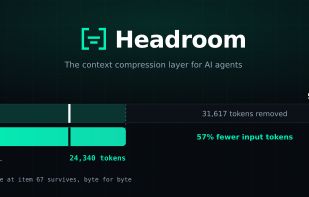
Headroom is a local-first context-compression tool for AI agents and LLM applications. It reduces the tokens sent to models by compressing tool output, logs, source files, RAG results, and conversation context—helping lower cost and preserve usable context without sending your data to a separate compression service.
• Compress more, spend less
Headroom routes content through specialized compressors for JSON, code, and prose, then sends the smaller context to your selected LLM provider. Its project benchmarks report meaningful reductions for agent workloads, while emphasizing that savings depend on payload type; repetitive JSON and logs benefit most, whereas short or dense prose may not.
• Key features
Local-first compression: Runs on your machine; prompts, files, and code are not sent elsewhere for compression.
Multiple integration modes: Use it as a Python or TypeScript library, local proxy, middleware, CLI wrapper, or MCP server.
Agent integration: Wrap supported tools such as Claude Code, Codex, Copilot CLI, Cursor, Aider, Cline, Continue, OpenCode, Goose, and OpenHands.
Content-aware routing: Applies JSON, AST-aware source-code, or text compression based on the input.
Reversible context: Stores original content locally and lets an agent retrieve it on demand when full detail is needed.
Cross-agent memory: Share a deduplicated local memory store between compatible agent workflows.
Output reduction: Optionally steers models toward shorter responses and reduces reasoning effort for routine tool-result turns.
Monitoring tools: Check setup with headroom doctor, measure performance, and view live savings through its dashboard.
Container-ready: Supports Docker-based deployment alongside standard Python and TypeScript installation paths.
• Built for AI workflows
Use Headroom when long coding-agent sessions, large tool responses, logs, search results, or retrieved documents make token usage expensive. Start a proxy with no application-code changes, wrap a supported coding agent, or add compress() directly into an existing application.







No comments or reviews, maybe you want to be first?