

Guardlayer icon
Guardlayer icon

Guardlayer

 Like

Static security scanner for Next.js and Supabase repositories that checks code and migrations for exposed secrets, disabled or missing RLS, risky policies, unsafe Server Actions, and unprotected API routes. It reports findings and exact fixes with pull-request checks.
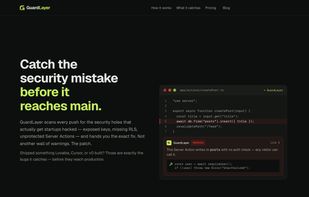
GuardLayer flags insecure Next.js and Supabase code and shows the exact fix

Cost / License

  • Freemium (Subscription)
  • Proprietary

Application type

Since

  • Since 2026

Platforms

  • Online
0likes
0articles
Save

Features

Features

Highlights All activities

Guardlayer News & Activities

Recent activities

Guardlayer information

  • Developed by

    Solvion Solutions
  • Licensing

    Proprietary and Freemium product.
  • Pricing

    Subscription that costs from $19 per month + free version with limited functionality.
  • Alternatives

    26 alternatives listed
  • Badge

    Get an embeddable badge for Guardlayer
  • Supported Languages

    • English
Guardlayer was added to AlternativeTo by solvionsolutions on and this page was last updated .

No comments or reviews, maybe you want to be first?

What is Guardlayer?

GuardLayer is a static security scanner built specifically for Next.js and Supabase applications. It analyzes application code and SQL migrations to catch the misconfigurations that commonly leak data: exposed anon or service_role keys, secrets leaked through NEXT_PUBLIC_ variables, disabled or missing Row Level Security, over-permissive RLS policies, tables granted to the anonymous role, public storage buckets, and Server Actions or API routes without authentication. Each finding comes with the exact fix inline.

It connects to GitHub as an app that scans every push and pull request, posting a pass/fail check and PR comment that can block merges when set as a required check. Code can also be uploaded for a one-off scan, a read-only live check shows which Supabase tables are publicly readable, and an MCP server lets AI coding tools run the checks. General checks cover hardcoded API keys, vulnerable dependencies, string-built SQL, and unsafe eval or dangerouslySetInnerHTML usage.

It is aimed at indie developers and small teams shipping quickly, especially with AI builders such as Lovable, Cursor, and v0. The free plan covers unlimited public repositories and uploads, while paid plans add private repository scanning, daily Supabase monitoring, team features, and Slack alerts.