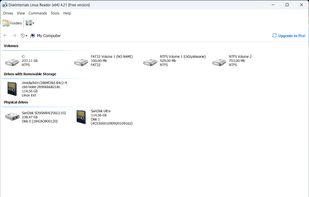
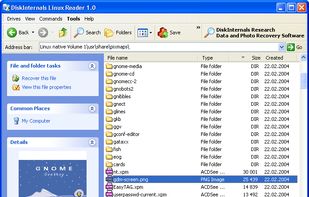
A freemium tool for reading files from EXT2/EXT3/EXT4, HFS, UFS2, Reiser4, and ReiserFS partitions in Windows. Some filesystem types locked restricted to "Pro" version.



FSproxy is described as 'Small application that lets you access GNU/Linux partitions from within Microsoft Windows. The list of detected partitions is always availible at \fsproxy. By default partitions are mounted as read-only but experimental write support can be enabled' and is an app. There are seven alternatives to FSproxy for Windows, Linux and Mac. The best FSproxy alternative is DiskInternals Linux Reader, which is free. Other great apps like FSproxy are Ceph, Ext2Read (Ext2Explore), BeeGFS and Lustre.
A freemium tool for reading files from EXT2/EXT3/EXT4, HFS, UFS2, Reiser4, and ReiserFS partitions in Windows. Some filesystem types locked restricted to "Pro" version.


Ceph is a distributed object store and file system designed to provide excellent performance, reliability and scalability.

Ext2Read is an explorer like utility to explore ext2/ext3/ext4 files. It now supports Linux LVM2. It can be used to view and copy files and folders. It can recursively copy entire folders. It can also be used to view and copy disk and file system images.

BeeGFS (formerly FhGFS) is a parallel cluster file system, developed with a strong focus on performance and designed for very easy installation and management.

Lustre is a massively parallel filesystem designed for high-performance, large-scale data.
It provides Windows NT4.0/2000/XP/2003/Vista/2008 with full access to Linux Ext2 volumes (read access and write access). This may be useful if you have installed both Windows and Linux as a dual boot environment on your computer.


XtreemFS is an object-based, distributed file system for wide area networks. The file system replicates objects for fault tolerance and caches metadata and data to improve performance over high-latency links. SSL and X.
It is like FSproxy but read-only. Use FSproxy if you want to modify file content