
Panning Poker Serbito icon

Panning Poker Serbito

Planning Poker is a free, open-source, real-time story-point estimation tool for agile and Scrum teams. Spin up a room in one click, share the link, and your whole team joins by name only — no accounts, no email, no paywall, no install.

Cost / License

  • Free
  • Open Source (MIT)

Platforms

  • Online
1like
0comments
0articles

Features

Panning Poker Serbito News & Activities

Highlights All activities

Recent activities

Panning Poker Serbito information

  • Developed by

    RS flagalxndr-bnd
  • Licensing

    Open Source (MIT) and Free product.
  • Alternatives

    13 alternatives listed
  • Supported Languages

    • English
    • Russian
    • German
    • Spanish
    • French
    • Portuguese
    • Serbian
    • Japanese
    • Chinese

AlternativeTo Category

Development

GitHub repository

  •  1 Stars
  •  0 Forks
  •  7 Open Issues
  •   Updated  
View on GitHub
Panning Poker Serbito was added to AlternativeTo by alexbond on and this page was last updated .
No comments or reviews, maybe you want to be first?

What is Panning Poker Serbito?

Planning Poker is a free, open-source, real-time story-point estimation tool for agile and Scrum teams. Spin up a room in one click, share the link, and your whole team joins by name only — no accounts, no email, no paywall, no install. Everyone votes at the same time, cards stay hidden until the reveal, and the result is summarized instantly so the team can discuss differences and converge on an estimate.

It's built for fast, friction-free sprint planning and backlog refinement, whether your team is remote, hybrid, or in the same room.

Key features

  • Instant rooms, zero sign-up — create a room and share a link; teammates join by name. No registration, no email, no credit card.
  • Real-time voting over WebSocket — vont rooms run in parallel.
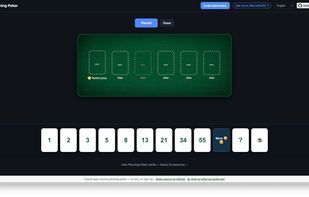
  • Hidden until reveal — individual votes stay secret while people pick, so no one anchors on the first number. Abstain cards (? and ? break)
  • Fibonacci deck — 1, 2, 3, 5, 8, 13, 21, 34, 55, 89, 144, 233, 377, 610, plus ? (unsure) and ? (break). Larger cards expand on demand.
  • Reveal & summary — one click reveals named votes with a distribution breakdown, average, and a consensusindicator.
  • Round history — each estimated item is logged (title + result) so you can track a planning session item by item.
  • Observer mode — facilitators, POs, or guests can join as non-voting observers (the 🎤 card) without skewing results.
  • Reconnect-safe — flaky Wi-Fi or a dropped connection won't lose your vote or your role; the session restores itself automatically.
  • 9 languages — English, Español, Deutsch, Français, Português, ???????, Srpski (Latin & Cyrillic), ???, ??.
  • Private by design — ephemeral, in-memory rooms; no database, no vote tracking, nothing stored after the room empties. How it works
  1. Create a room — open the site, get
  2. Invite the team — everyone joins by name; no account needed. 3. Estimate — pick a card, reveal, seensus, then reset for the next item. Why teams pick it
  • Genuinely free & unlimited — no seate for more rooms."
  • No data lock-in — nothing to sign up for, nothing stored. - Open source (MIT) — inspect it, forkthub.com/alxndr-bnd/planning-poker.
  • Fast & lightweight — a single small SPA + WebSocket service; scales to zero when idle, so it stays free to run and instant when you need it.

Official Links