EbookForge icon
EbookForge icon

EbookForge

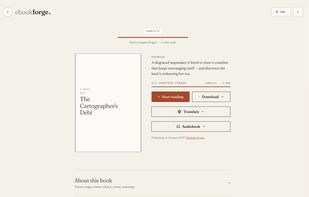
An AI book studio that takes you from premise to a finished, KDP-ready manuscript with a designed cover — exported as PDF and EPUB.
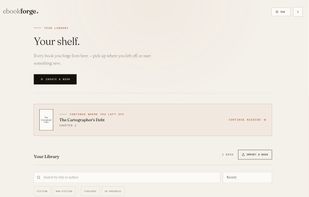
Your shelf. Every book you forge lives here — pick up exactly where you left off.

Cost / License

  • Pay once or Subscription
  • Proprietary

Platforms

  • Online
  • Software as a Service (SaaS)
One idea, one finished book. Read it, export KDP-ready, translate it, or turn it into an audiobook.
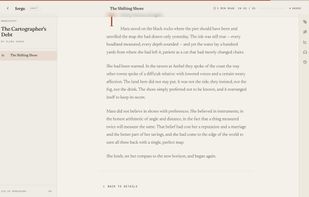
A distraction-free reading column with your author tools one tap away.
+7
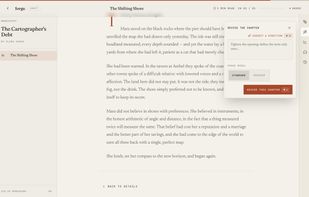
Revise with AI. Give a direction — the studio rewrites the whole chapter in your voice.
0likes
0comments
0alternatives
0articles

Features

Properties

  1.  Distraction-free
  2.  Lightweight
  3.  Privacy focused
  4.  AI-Powered

Features

  1.  Ad-free
  2.  No Coding Required
  3.  Text to Speech
  4.  Live Preview
  5.  Cloud Sync
  6.  Dark Mode
  7.  Audio Books
  8.  Distraction-free Writing
  9.  Desktop Publishing
  10.  Copywriting
  11.  Publishing
  12.  AI Writing
  13.  Self-publishing
  14.  Workflow Automation
  15.  Web-Based

EbookForge News & Activities

Highlights All activities

Recent activities

EbookForge information

  • Developed by

    Sam (Solo Developer)
  • Licensing

    Proprietary and Commercial product.
  • Pricing

    One time purchase that costs from $6, and / or subscription that costs up to $230 per month.
  • Alternatives

    0 alternatives listed
  • Supported Languages

    • English
EbookForge was added to AlternativeTo by Sam on and this page was last updated .
No comments or reviews, maybe you want to be first?

What is EbookForge?

EbookForge is an AI book studio for self-publishing authors. It takes a book from premise to finished manuscript — outline, chapters, and a designed cover — and exports print-ready PDF and EPUB files formatted to Amazon KDP requirements. You steer the draft, sharpen the voice, and publish under your own name.

What separates EbookForge from prompting a chatbot is the pipeline underneath. The AI is used only for semantic work — prose, ideas, voice — while structure, continuity, formatting and consistency are owned by deterministic code. Chapters are produced through a divide-and-conquer pipeline built to keep a long manuscript coherent instead of drifting into repetition, and covers come from a dedicated design engine rather than a raw image prompt. The result is a book that holds together at 200 pages, not just at 2,000 words.

Official Links