


ClassicPress
11 likes
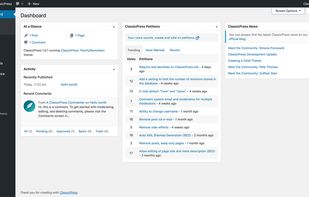
ClassicPress is a community-led open source content management system and a fork of WordPress that preserves the TinyMCE classic editor as the default option, which means there is no Gutenberg (block) editor.

Cost / License
- Free
- Open Source
Application typeApplication types
Platforms
- Self-Hosted

Features
Highlights All activities
ClassicPress News & Activities
Recent activities
 Bugra-Bodur added ClassicPress as alternative to DonkeyCMS
 Sandeep-Kumar added ClassicPress as alternative to Radius CMS
 Thomas Smauel added ClassicPress as alternative to ULTRV
 c17s5qhu added ClassicPress as alternative to PureBlog
 Paul added ClassicPress as alternative to EmDash CMS
 Kopage added ClassicPress as alternative to WEBSITE•IM
 WebOrbiton added ClassicPress as alternative to FlatlyPage
 pivlu added ClassicPress as alternative to Pivlu


WordPress Alternatives for Self Publishers
By the end of 2016 I felt WordPress was not working for me as a self publisher. I've been creating and maintaining my own sites since 1996, in one format or another. What I want in a CMS is a word processor for the web. Marketing, SEO, and fancy gimmicks are secondary to creating, publishing, and distributing content. I don't want to spend time learning and relearning how to use software. I'm picky about web design and I don't jump on trends just because they are new and flashy. Yes, I want my site to be read, but SEO and marketing are a slippery slope when it comes to ethics and trust. People don't read sites that focus on marketing - the more marketing hype, the less real readers.
WordPress is definitely geared to pleasing web developers and marketers, people who offer services like beginning a site, curation, maintenance and running a site for people who don't want to run a site themselves. People want automated sites to sell stuff. But, that's not what I want to do. So I left WordPress.
Over most of 2017 I tried alternatives to WordPress. I wanted a CMS (content management software) to be user friendly, rather than having to understand API and REST and other things I don't need or want to learn. I wanted something with the features WordPress keeps eliminating like keeping a list of links, having a bookmarklet to post links and content from other sites via my web browser. Very important was to find a CMS which was not mothballed and not focused on how they can make a buck from me. Also, self hosted.
I had a very hard time moving my sites out of WordPress and into anything else. Most other CMS do not have a way to migrate your sites, reliably. I've realized the best way to move sites from WordPress is not to migrate anything. Leave the old site up, just change it to a subdomain and start fresh on the main domain with which ever WordPress alternative you want to start using. You can move posts over manually, one by one. Or, you can use your old post content and create an updated post based on what you had written before. This would be simpler than trying to bring back your entire old site, especially if it was huge.
I have tried far more CMS than I am adding to this list. To be honest, I don't remember most of them well enough to give a review. Several were complicated to install which did not seem like a good beginning to use them to publish a site. So this list is mainly the highlights and lowlights of my CMS adventures beginning in 2017 and still ongoing in 2020.
Developed by
 ClassicPress Initiative
 Licensing
Open Source and Free product.Rating
Average rating of 4.2Alternatives
30 alternatives listedBadge
Get an embeddable badge for ClassicPressSupported Languages


Comments and Reviews
It is a good alternative to WP for anyone who doesn't want to learn new software, just get out of mainstream/ commercially focused WordPress.
Been hoping for years someone would do this to WordPress. WP is a developers nightmare with too much conflicting code, and bloat. I'm hoping I can navigate clients web needs better with this. Time will tell.
ClassicPress 1.4.0 does not run on PHP 8.0 or 8.1 in my case, only PHP 7.4 (as of April 2nd 2022). Development is very sluggish, so I wonder how future-proof this CMS is. Their website gives the information that PHP 8 is not supported as of yet.
Well, the older version 1.3.1 does work on PHP 8, strange as it seems.
I love WordPress pre-Gutenberg, that's why I enjoy using ClassicPress. It has no Gutenberg, which means it's lightweight and performance better than WordPress now. Plus, changes in ClassicPress are community-led. Much better than having Automattic control WordPress.
For developers with projects going awry due to Gutenberg, it can be a life saver.
clean and honest. Ethical. no bloat. Technically based on the good things about WordPress, leaving behind the bad things.
I like ClassicPress because it operateslike WP used to do. Keeping theme and styling separate from content. You can usually update a site by changing the theme and minor onpage editing as the one style sheet controls the whole site.