Calib Camera Calibrator icon

Calib Camera Calibrator

Commercial desktop software for geometric camera calibration: single-camera, N-camera stereo with joint bundle adjustment, multi-camera systems and multi-target setups.
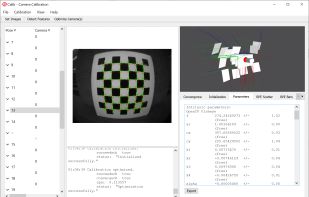
Calib Camera Calibrator screenshot 1

Cost / License

  • Pay once
  • Proprietary

Platforms

  • Windows
  • Mac
  • Linux
0likes
0comments
0articles

Features

Calib Camera Calibrator News & Activities

Highlights All activities

Recent activities

Calib Camera Calibrator information

  • Developed by

    DK flagCalib.io ApS
  • Licensing

    Proprietary and Commercial product.
  • Pricing

    One time purchase (perpetual license) ranging between $150 and $2000.
  • Alternatives

    1 alternatives listed
  • Supported Languages

    • English

Popular alternatives

View all
Calib Camera Calibrator was added to AlternativeTo by myosin on and this page was last updated .
No comments or reviews, maybe you want to be first?

What is Calib Camera Calibrator?

Calib Camera Calibrator is a commercial geometric camera calibration application from calib.io, available both as a Windows and Linux desktop GUI and as a C++ shared library (libCalib) for integration into other software. It covers single-camera calibration, N-camera stereo calibration with joint bundle-adjustment optimisation, simultaneous calibration of multi-camera systems, and the use of multiple calibration targets to cover larger fields of view. A broad range of camera models is supported, including OpenCV's 18-parameter Brown/Conrady model and its Brandt/Kannala fisheye model, the Double Sphere and Enhanced Unified models, a B-Spline model, Halcon's division model, the Devernay/Faugeras FOV model and Weng's thin-prism model. Supported targets include regular checkerboards, regular and asymmetric circle grids, ChArUco, ArUco and Kalibr AprilGrid patterns. Beyond the parameters themselves, the software puts strong emphasis on assessing calibration quality: covariance estimation and parameter correlation analysis, per-camera, per-pose and per-feature reprojection-error statistics, simulation of the triangulation error distribution, statistical normality and independence tests, and visualisations of residual directions and magnitudes across the image plane. Calibrated models can be exported as undistortion and unprojection maps.