AnalogTV recreates the complete analogue television chain — broadcast camera tube, composite signal encoding, RF transmission, and CRT phosphor display — simulated from physical first principles. Not a vintage filter. Not a post-process effect. A working simulation of every stage of broadcast television, from the camera neck to the phosphor screen.
THE COMPLETE BROADCAST CHAIN
Every frame passes through the same stages as a real television signal. A camera tube model — Image Orthicon, Plumbicon, Vidicon, or CCD — captures the scene with its characteristic lag, halation, and MTF response. The signal is composite-encoded to NTSC, PAL, or SECAM standards, then decoded through the same mathematics a real television receiver performs. A Metal GPU fragment shader renders each frame onto a simulated CRT phosphor display at 60 fps.
EIGHT PHOSPHOR TYPES
P22 colour television. P31 oscilloscope green. P45 white sub-millisecond. P4 B&W television. P3 amber radar. P7 dual-persistence radar — white flash fading to yellow-green afterglow. P11 deep blue photographic. P24 cyan-green flying-spot. Each calibrated from manufacturer datasheets and IEEE literature. Each shifts the IIR decay constants, rendered colour, and shutdown spot tint independently.
SERVICE MENU
Access the hidden service menu to make adjustments a television engineer would use: RGB drive and cutoff, convergence, focus voltage, G2 screen voltage, purity, HV regulation, and degauss. Every control operates at the physics level — changing focus changes the modelled electron beam diameter, not a software blur.
MAGNET
Press a virtual permanent magnet against the faceplate and watch the shadow mask magnetise. Drag to paint a continuous smear of purity damage across the screen. The magnetisation field persists across restarts. Degauss triggers the PTC thermistor coil sequence and clears it over 1.8 seconds.
TUBE AGEING AND SHUTDOWN
Cathode emission falls with use. The screen accumulates burn-in at sustained high-brightness areas. Shut the set down and watch the EHT bleed, beam defocus, and phosphor decay to darkness — with optional HV arc sounds.
14 TEST PATTERNS
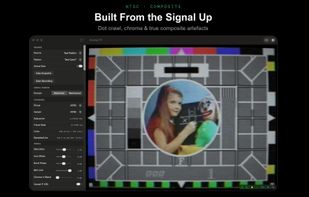
SMPTE and EIA colour bars, pluge, crosshatch, multiburst, zone plate, flat fields, and more. Every pattern is generated mathematically in real time.






 Paul added Analog TV as alternative to Glaze for Mac


No comments or reviews, maybe you want to be first?