


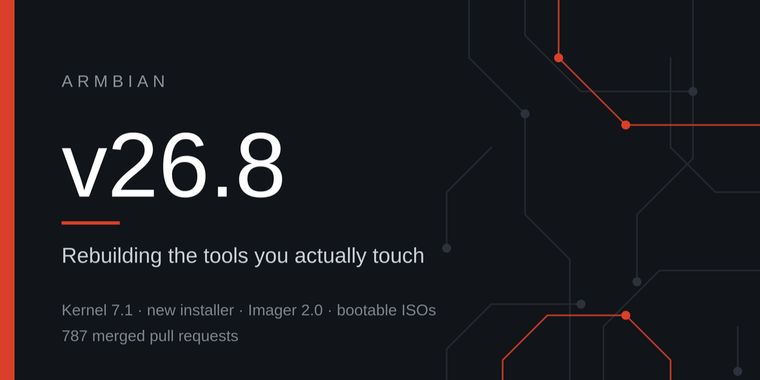

Armbian 26.8 launches with Linux 7.1 kernel, a rewritten installer, and UEFI ISO Images
Armbian 26.8 delivers a major update to this system image framework for single-board computers, introducing feature, compatibility, and workflow enhancements for its users. The installer has been completely rewritten as an armbian-config module and now benefits from unit testing. It separately handles eMMC and NVMe, supports SPI and MTD targets, flashes bootloaders independently, and properly reports bootloader flash failures rather than giving misleading positive messages.
Alongside the installer, Armbian 26.8 advances its mainline kernel support to Linux 7.1 as stable, with Linux 7.2 available on edge branches for rockchip64, meson64, mvebu64, sunxi, and bcm2711. The U-Boot bootloader is updated to v2026.07 for most supported boards, including the Rockchip RK35xx family, Amlogic, i.MX6, and mvebu platforms. These backend changes enable improved hardware compatibility, with new single-board computers joining the list, 14 boards moving to standard support, several dropped to community support, and Banana Pi R2 returning with Linux 6.18.
Following these upgrades, Armbian Imager 2.0 introduces QDL and UFS flashing for Qualcomm hardware, uses real-time board data from the Armbian API, and allows UEFI images to be produced as bootable live ISOs that can be deployed via IPMI virtual CD or in cloud environments. Driver reliability has also increased, with several Realtek and UWE drivers now maintained in dedicated repositories, cleaner builds up to Linux 7.2, and many fewer compiler warnings. The continuous integration pipeline now resides in its own repository, features NetBox-based runner registration and auto-retries, while riscv64 images are built natively and kernel patch processes operate in parallel.




- Linux Distro
- Free
- Open Source
Related news
External links
- Armbian release 26.8Armbian • Official source
- Armbian 26.8 Released With Installer Rewrite, UEFI ISO ImagesPhoronix
- Armbian 26.8 Released with Linux 7.1, Revamped Installer, and UEFI ISO Images9to5Linux
- Armbian 26.8 Released with Linux Kernel 7.1 and Rewritten InstallerLinuxiac
- Armbian 26.8 releasedLWN.net
No comments so far, maybe you want to be first?